


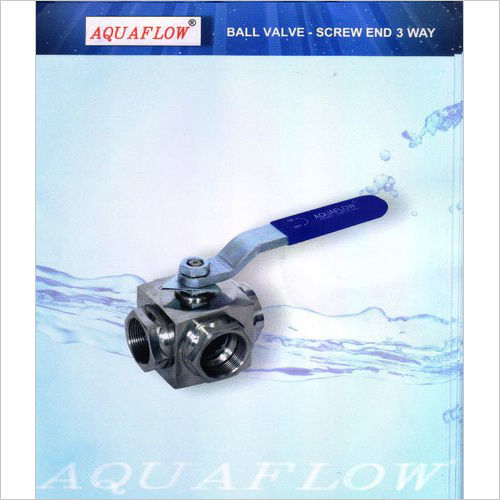
Aquaflow Ball Valve - Screw End 3 Way Stainless Steel
850 INR
Product Details:
- Structure 3 Way Ball Valve
- Material Stainless Steel
- Power Manual
- Pressure High Pressure
- Media Water, Oil, Gas
- Working Temperature -20C to 180C
- Port Size 1/2 to 2
- Click to View more
X
Aquaflow Ball Valve - Screw End 3 Way Stainless Steel Price And Quantity
- 10 Piece
- 850 INR
Aquaflow Ball Valve - Screw End 3 Way Stainless Steel Product Specifications
- Stainless Steel
- -20C to 180C
- 3 Way
- 3 Way Ball Valve
- High Pressure
- Manual
- Water, Oil, Gas
- 1/2 to 2
- Polished
- Industrial, Chemical, Water, Oil, Gas
- Screwed Ends
- Stainless Steel with PVC grip
- SS304 / SS316
- 3
- PTFE (Teflon)
- Full Bore
- Excellent
- L-Port or T-Port
- Screwed End / BSP (Threaded)
- Class VI
- Lever Handle
Aquaflow Ball Valve - Screw End 3 Way Stainless Steel Trade Information
- 50 Piece Per Week
- 1 Week
Product Description
Specification
| Way | 3 WAY |
| Temperature Of Media | High Temperature |
| Design | 3 WAY STAINLESS STEEL |
| WOG Rating | 150 |
| Connector Type | Screwed |
| Brand | AQUAFLOW |
| Material | Stainless Steel |
| Pressure | High Pressure |
Robust 3-Way Flow Control
This valve features a three-way design, allowing versatile control over fluid direction and distribution. The full bore construction ensures minimal flow restriction, making it suitable for a wide range of industrial and chemical processes. Its L-port or T-port body designs can accommodate different flow configurations for targeted system requirements.
Durable Stainless Steel Construction
Made from high-grade SS304 or SS316 stainless steel, the valve resists corrosion and maintains integrity in harsh environments. The polished surface enhances both aesthetic appeal and cleaning ease, while the stainless steel handle with PVC grip guarantees long-lasting manual operation.
Leak-Proof Performance with PTFE Seats
Equipped with PTFE (Teflon) seats, the ball valve offers Class VI leak-tight sealing. This ensures maximum safety and efficacy, especially when handling critical media like chemicals, gases, or industrial fluids. The material selection guarantees compatibility and reliability at working temperatures from -20C up to 180C.
FAQs of Aquaflow Ball Valve - Screw End 3 Way Stainless Steel:
Q: How does the Aquaflow 3-way ball valve facilitate flow control in industrial applications?
A: The valves three-way L-port or T-port design allows users to divert, mix, or shut off flows efficiently between different pipelines. With a full bore configuration, it minimizes pressure drops and maximizes flow volume, making it highly effective for complex fluid management in industries.Q: What are the benefits of using stainless steel SS304/SS316 for the valve body?
A: SS304 and SS316 provide excellent durability, corrosion resistance, and longevity, particularly in chemically aggressive or high-pressure environments. These materials also maintain mechanical strength across a wide temperature range, ensuring reliable performance and minimal maintenance.Q: When should you choose a PTFE (Teflon) seat in a ball valve?
A: A PTFE seat is best used when dealing with corrosive fluids, high-temperature operations, or applications requiring superior chemical resistance. Its low friction coefficient also enhances leak prevention and valve longevity under frequent use.Q: Where can Aquaflow 3-way ball valves be installed?
A: They are ideal for installation in industrial setups, chemical plants, water treatment facilities, oil and gas processing systems, and anywhere precise and durable flow control is required. Suitable for both new installations and upgrades within Indias supply chain.Q: What is the process for operating the valve manually?
A: The valve is equipped with a stainless steel lever handle featuring a PVC grip. To adjust flow, the operator simply turns the handle to direct the fluid between the desired ports efficiently. The robust design ensures smooth, consistent operation even in high-pressure systems.Q: What is the leakage class of this valve, and why is it important?
A: This valve is rated Class VI for leakage, indicating bubble-tight performance. This rating is critical in applications where even minimal leakage could compromise safety, product quality, or environmental standards.Tell us about your requirement

Price:
Quantity
Select Unit
- 50
- 100
- 200
- 250
- 500
- 1000+
Additional detail
Mobile number
Email

Other Products in 'Aquaflow Brand Valves' category


Export Countries :- Uae, Kuwait, Qatar, Bahrain, Saudi Arabia, Turkey, Jordan Egypt, Oman, Iraq, Israel Full, Africa, Azerbaijan, Libya, Tunisia, Morocco, Syria, Iran, Turkmenistan, Uzbekistan, Comoros
Contact Us

- 5-1-570, Hill Street, Near City Lite Hotel, Ranigunj, Secunderabad - 500003, Telangana, India
- Phone :08071794384

- Mr Huzefa BHAIMOMIN (Proprietor)
- Mobile :08071794384
- Send Inquiry
 Send Inquiry
|

Products


 Send Inquiry
 Send SMS
 Call Me Free
UNIQUE INDUSTRIALS
All Rights Reserved.(Terms of Use)
Developed and Managed by Infocom Network Private Limited.
Developed and Managed by Infocom Network Private Limited.


